 Tulum City Guide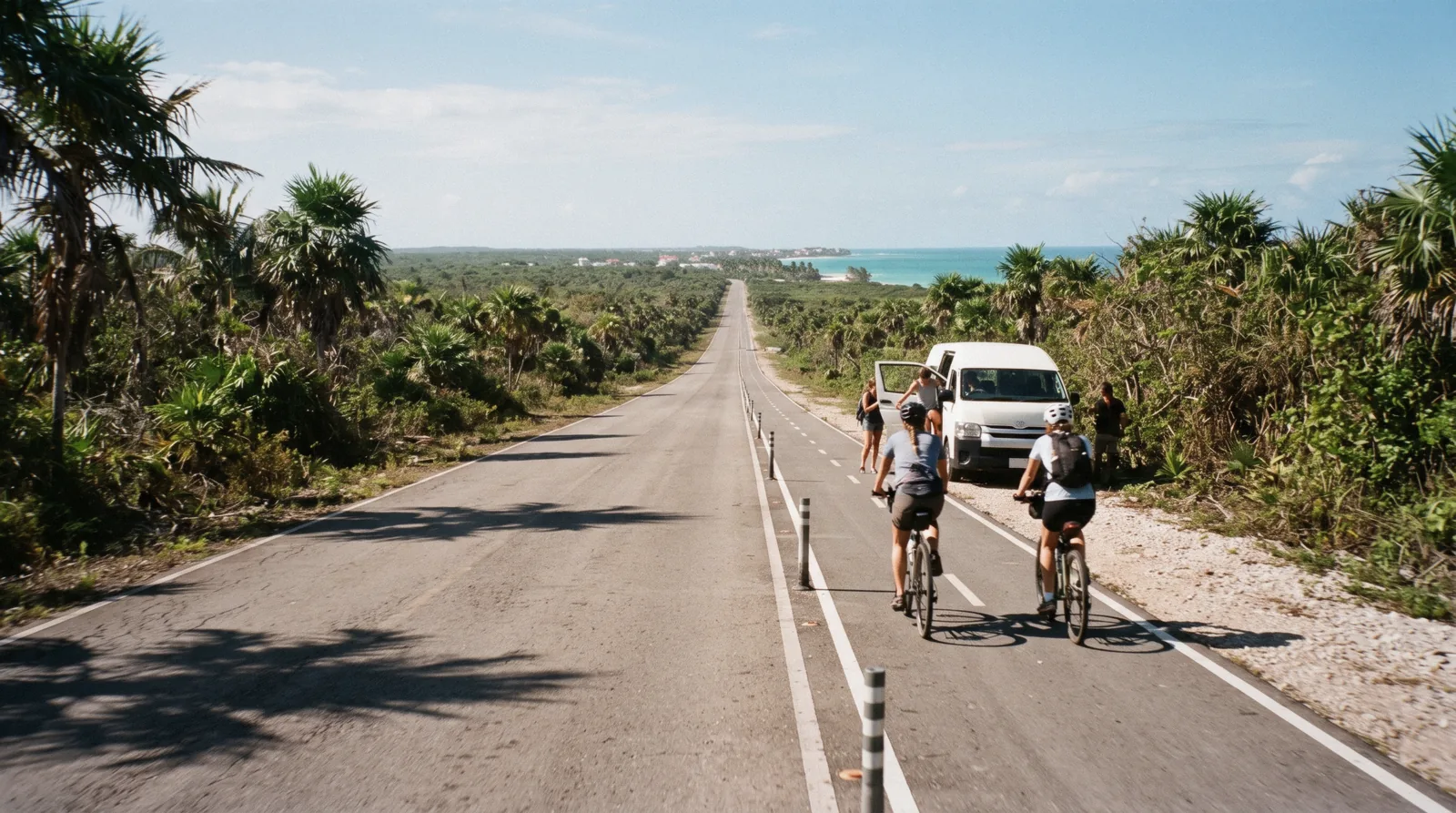
Getting Around Tulum
How to get around Tulum is the part of the trip that quietly decides your budget. The town and the beach strip are four kilometres apart on a flat, straight, shadeless road; the cenotes and the ruins are strung along two highways served by shared vans; and taxis here carry no published tariff, which is why the same journey can cost three different amounts in one day. The rest of the planning sits in the Tulum, Mexico city guide.
Quick answer Which way, what it costs, and where each one fails
A bicycle covers the town, the beach road and the near cenotes. Colectivos — shared white vans — run Highway 307 and the Cobá road all day and stop when you wave. Taxis have no meter and no published tariff, so every fare is negotiated first. A rental car only earns its keep for Cobá, the far cenotes and the reserve.
Key takeaways
- The cheapest way to the Cobá-road cenotes is a hired bicycle, and it is genuinely pleasant before ten in the morning
- The colectivo is how locals reach Muyil, Akumal and the cenote gates on Highway 307 — flag it down, pay in cash, small notes
- Agree every taxi fare before you get in: there is no meter, and the beach road at night is the most expensive ride in town
- A car makes sense for Cobá and Sian Ka'an; it is a liability on the beach road, where parking is paid and scarce
The five ways to move, compared
What each option is good for and where it stops working, based on the distances on this coast: town to beach road about 4 km, town to the first cenotes 3–8 km, Highway 307 north to Akumal about 25 km, west to Cobá about 47 km.
| Way | Good for | Where it fails | Pay with |
|---|---|---|---|
| Bicycle | Town, the beach road, the Cobá-road cenotes | Highway 307, rain, after dark | Cash, day rate |
| Colectivo (shared van) | Highway 307 and the Cobá road, gate to gate | Cobá village, late evenings, luggage | Cash, small notes |
| Taxi | Night, luggage, groups | Any time you have not agreed the price | Cash; agree first |
| Rental car | Cobá, the reserve, the far cenotes | Beach-road parking, one-town stays | Card at the desk, cash for parking |
| Scooter | Short hops in town | Highway speeds, rain, most travel insurance | Cash or card, check the cover |
There is no city bus network in Tulum and no published taxi tariff. What looks like a fixed price on a laminated card at a hotel desk is that hotel's arrangement, not a municipal rate.
The colectivo, and how to use one
The white shared vans are the backbone of transport on this coast, and using them is easier than it looks.
They run two useful routes from Tulum: north and south along Highway 307, between Playa del Carmen, Tulum and the villages beyond; and west along the Cobá road past the cenotes. There is no timetable — they leave when they are full and pass frequently through the day — and no ticket. You wave one down from the roadside, tell the driver where you are going, and pay in cash when you get out.
What matters in practice: carry small notes, sit where you can reach the door, and say the name of your stop clearly when you board — Gran Cenote, Muyil, Akumal arch. The service thins in the late afternoon and is unreliable after dark, which is the one thing that catches people out on the way back from a cenote.
Where the colectivo does not go
It does not usefully serve Cobá, which sits off a different road with a thin service, and it does not go to Chichén Itzá at all — the trips the shared vans cannot solve are on the day-trips page. It also cannot solve the beach road, which is a different geography: for that it is a bicycle, a taxi, or a long hot walk.
The bicycle, and the four kilometres
Tulum is flat, and that single fact makes the bicycle the local answer to almost everything within eight kilometres.
Rental shops in town hire by the day, and most hotels either lend bicycles or arrange them. The ride from the town centre to the beach road takes about twenty minutes on a signed path beside the road; Cenote Calavera is roughly ten minutes west and Gran Cenote a little further, both on a flat shoulder with room to ride.
The caveats are honest ones. The path is not continuous and it is unlit, so the ride home from the beach after dinner is a dark road shared with taxis — lights matter. Nothing on Highway 307 is a sensible cycle: it is fast, and the shoulder is where the colectivos stop. And in the middle of the day between May and September, the combination of no shade and 30 °C is more punishing than the distance suggests.
Taxis: no meter, no tariff, one rule
This is the part of Tulum that generates the most complaints, and it is structural rather than personal.
There is no meter in a Tulum taxi and no published municipal tariff that a visitor can consult. The fare is what the driver quotes and you accept, and it varies by time of day, by direction, and by where you are standing when you ask. The beach road is dearer than the town, and the small hours are dearer again.
The rule that removes the problem: agree the number before the door closes, in pesos, for the whole car rather than per person, and have it in cash. If the quote sounds wrong, the next taxi is thirty seconds away. Hotel desks will call one and often quote a fixed price — that is the hotel's arrangement, not a rate, but it is a useful benchmark.
Ride-hailing apps have had a fraught history in Quintana Roo, with disputes between drivers and the taxi unions. Do not build a plan around one being available.
When a rental car earns its keep
A car solves exactly three problems here, and creates two.
It solves Cobá, which the colectivo does not reach; the far cenotes and Sian Ka'an, where you are otherwise dependent on tour timetables; and any day where the return leg would fall after dark. On a stay of four nights or more that covers several of those, it is usually cheaper than the taxi equivalent.
It creates parking, which on the beach road is paid, scarce and enforced; and it creates exposure to the roadside-fine scam the UK advisory warns about, which specifically targets rental-car drivers. Fuel is sold by attendants at the pump, in cash or by card, and it is normal to watch the meter being zeroed.
One road deserves a warning of its own: the coastal track south of the Arco Maya gate toward Punta Allen is 50 kilometres of unpaved road, slow in the dry season and worse after rain. Most rental agreements exclude it.
Getting to Tulum in the first place
Three arrival routes, and they are not equally convenient.
Tulum's own airport, Felipe Carrillo Puerto, opened in December 2023 and is the closest — the airport page covers the transfer options and what flies there. Cancún airport is about 90 minutes north on Highway 307 and still carries the great majority of international flights, with shuttle, ADO bus and private transfer all available. The ADO bus arrives at the terminal on Avenida Tulum in the middle of the town, which is the most convenient arrival point of the three if you are staying in the centre.
The Maya Train also serves Tulum, with a station west of the highway. Fares are sold only inside its own booking engine and no public fare table was readable on trenmaya.gob.mx when we checked on 29 August 2026, so this site does not print one.
| Arriving by | Where it drops you | Onward |
|---|---|---|
| Tulum airport (TQO) | Southwest of town | Pre-booked transfer or taxi; see the airport page |
| Cancún airport (CUN) | 90 minutes north | ADO bus, shuttle or private transfer |
| ADO bus | Avenida Tulum, town centre | Walk, bicycle or a short taxi |
| Maya Train | Station west of Highway 307 | Taxi into town; fares not published outside the booking engine |
Where this leads
Transport decides where you sleep and how much the day costs.
Where to stay
The address decides the taxi bill more than the room does. The where-to-stay page prices the three strips against each other.
Beach road, town, or the grids betweenTulum airport
What flies to TQO, how far it is from town and what a transfer costs — the airport page covers the arrival.
The newest way inDay trips from Tulum
Cobá and Chichén Itzá are the trips the shared vans cannot solve. The day-trips page does the cost arithmetic.
Where the colectivo stops workingGetting around Tulum: what people ask
How much is a taxi in Tulum?
There is no published tariff, so the honest answer is: whatever you agree before you get in. Fares are higher on the beach road and higher again at night. Agree the number for the whole car in pesos, in cash — the taxi section explains why this is structural rather than a scam.
How do the colectivos work in Tulum?
Do you need a car in Tulum?
Not for the town, the beach or the near cenotes, which a bicycle covers. Yes, effectively, for Cobá and for reaching Sian Ka'an on your own schedule — though for both of those a shared tour is often cheaper than the car plus fuel plus parking.
Is Uber available in Tulum?
Ride-hailing in Quintana Roo has had a difficult history with the taxi unions, and availability has come and gone. Do not build a plan around it: assume taxis with negotiated fares, a bicycle by day, and a pre-booked transfer for the airport.
How far is the beach from the town centre?
About four kilometres, flat and straight, roughly twenty minutes by bicycle on a path beside the road. It is unlit for most of its length, which matters on the way home — the bicycle section covers what that means in practice.
How do you get from Cancún airport to Tulum?
About 90 minutes south on Highway 307 by ADO bus, shuttle or private transfer. The bus arrives at the terminal on Avenida Tulum in the town centre, which is the easiest arrival if you are staying in the centre — the getting-here section sets out the four routes in.
Page last reviewed 2026-08-29. Prices, hours and terms are set by the venue or operator and confirmed at checkout.
We may earn a commission if you book through one of our links, at no extra cost to you. Full affiliate disclosure