The Castillo temple on its limestone cliff above the Caribbean at first light, Tulum Mexico
Tulum, Mexico: An Independent City Guide
Tulum, Mexico now charges one gate fee where it used to charge three: INAH publishes MX$265 for a foreign adult at the ruins and states it already covers the national park and the Parque del Jaguar. This guide prints what each gate asks, the day it was read and the page it came from — cenote gates included, where almost nobody publishes a price at all.
Quick answerWhat a day costs, how long to stay, what to book — in four lines
Tulum is two places four kilometres apart: a working town on Highway 307 and a beach road of hotels behind the dune. The ruins open daily 08:00–17:00 with last entry at 15:30 and cost MX$265 for a foreign adult in one unified payment; the cenotes around it charge MX$300–400 in cash at the gate. Three nights covers the ruins, two cenotes and one reserve day without rushing.
Key takeaways
INAH publishes MX$265 (about $16) as a costo unificado for foreign visitors at the ruins, stating it already includes the CONANP charge and the Parque del Jaguar fee — read on 29 August 2026 and explained on the ruins ticket page
Sundays are free at every INAH site for Mexican nationals and foreign residents, which makes Sunday the busiest morning at the ruins — the timing detail sits in what to see first
Tulum in five decisions: what to pay, where to swim, where to sleep
Five hubs, each with the three facts that settle it. Everything else on this site hangs off one of them.
Beach road, town, or the new residential grid — the choice sets your taxi bill.
The beach road buys you the dune and costs you every trip into town
Tulum pueblo puts the ADO terminal, the banks and the cheap food outside your door
Where to eat splits the same way: taco stands in town, tasting menus behind the dune
The beach road is 4 km from town, and taxis have no published tariff
Tulum must-see list, in the order the coast actually runs
Everything worth the trip sits on one 60-kilometre line: the ruins on the cliff, the cenotes inland along Highway 307 and the Cobá road, the reserve to the south, Cobá in the forest west. Take them in this order and the hours fall into place — the ruins at opening while it is cool, fresh water in the heat of the day, the reserve on its own morning.
1. The Tulum ruins
The only walled Maya city on a Caribbean cliff, and a small one: an hour inside the walls, ninety minutes with the cliff viewpoints. Open daily 08:00–17:00 with last access at 15:30, and MX$265 (about $16) for a foreign adult in one unified payment that INAH states already covers the national park and the Parque del Jaguar fee. There is no shade in it, which is the whole argument for the 08:00 gate.
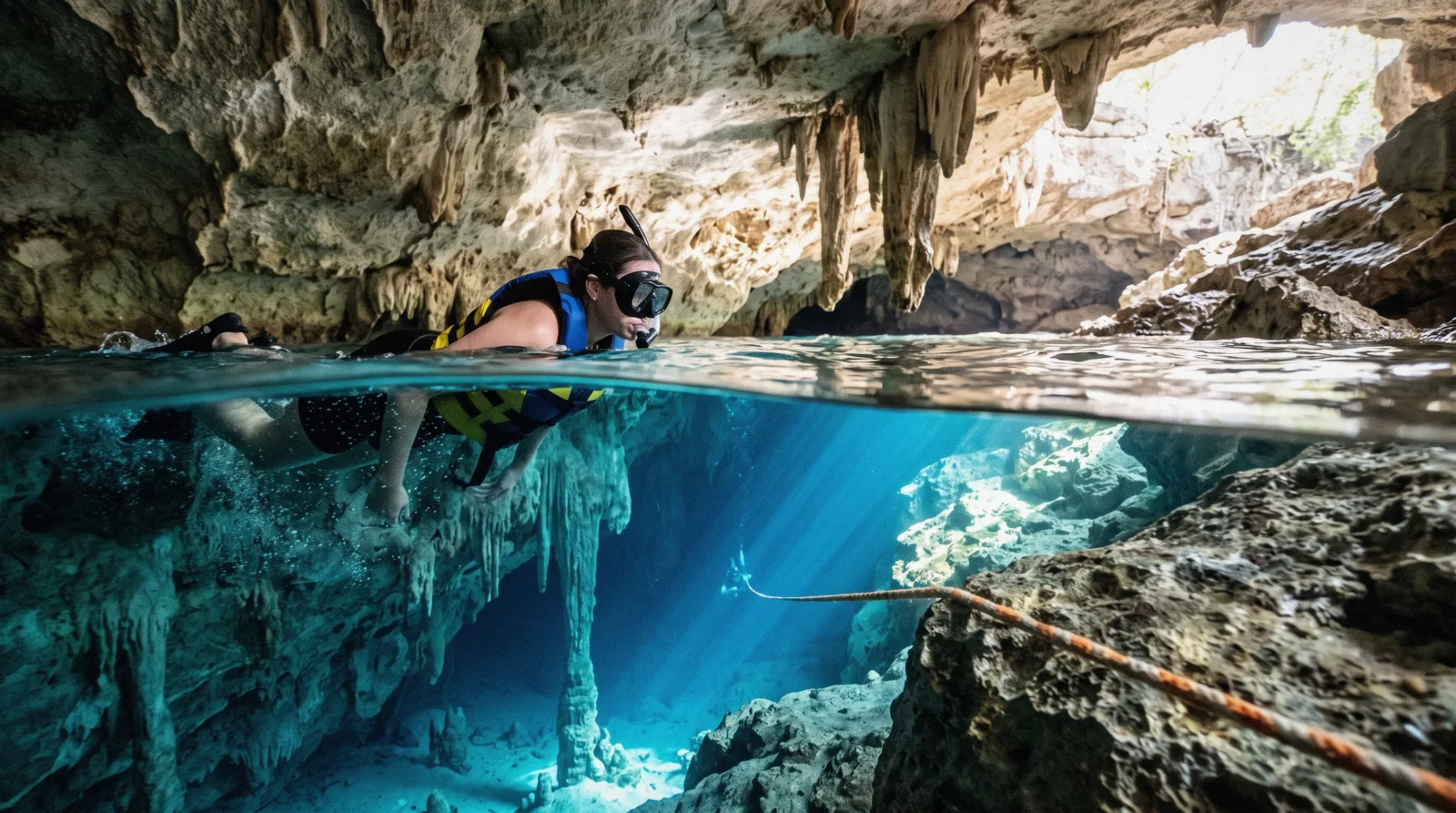
The cavern snorkel every photograph of Mexican cenotes comes from: two flooded openings joined under the rock by a passage lit from both ends, on the Sac Actun system and its 376 kilometres of mapped galleries. MX$400 (about $24), open 08:00–17:00 with last entry 15:30, and the only cenote near Tulum that publishes a tariff, takes cards and holds a booking. Nicte-Ha in the same park is MX$300 and shallow. The Dos Ojos page sets the six cenotes of that park side by side.
3. The cenotes on the Cobá road
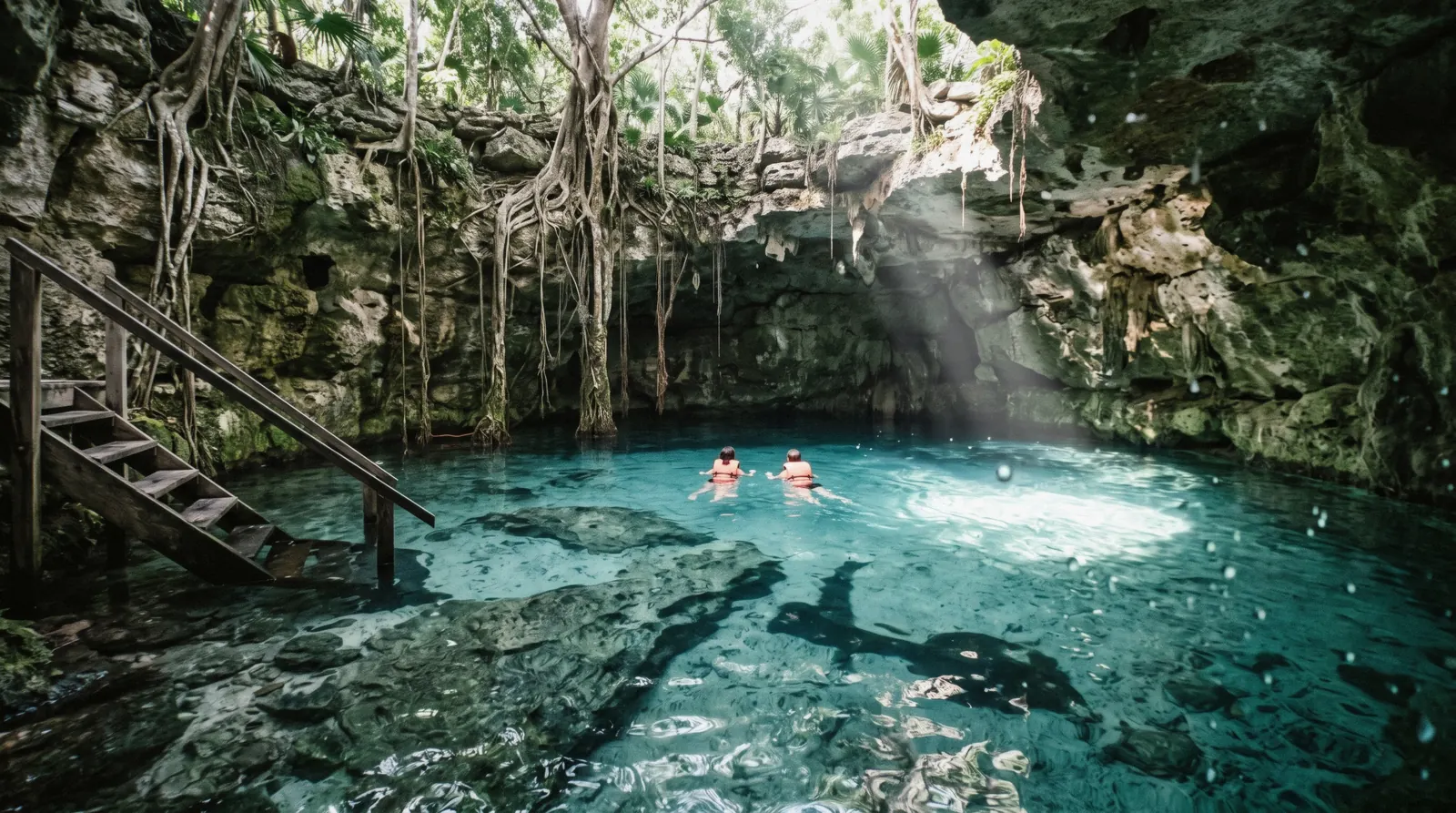
Gran Cenote, Calavera and Zacil-Ha lie within eight kilometres of the town on one road, which makes them the cenotes you can reach by bicycle before breakfast. None of the three publishes a price or an opening time anywhere online, so they are cash gates: bring pesos and arrive when they open. Calavera is jumping rather than swimming, Gran Cenote has the cave passage and the turtles, Zacil-Ha is the calm one. The cenote index numbers them to a map and marks which gates publish a tariff at all.
4. Sian Ka'an and the Maya canal
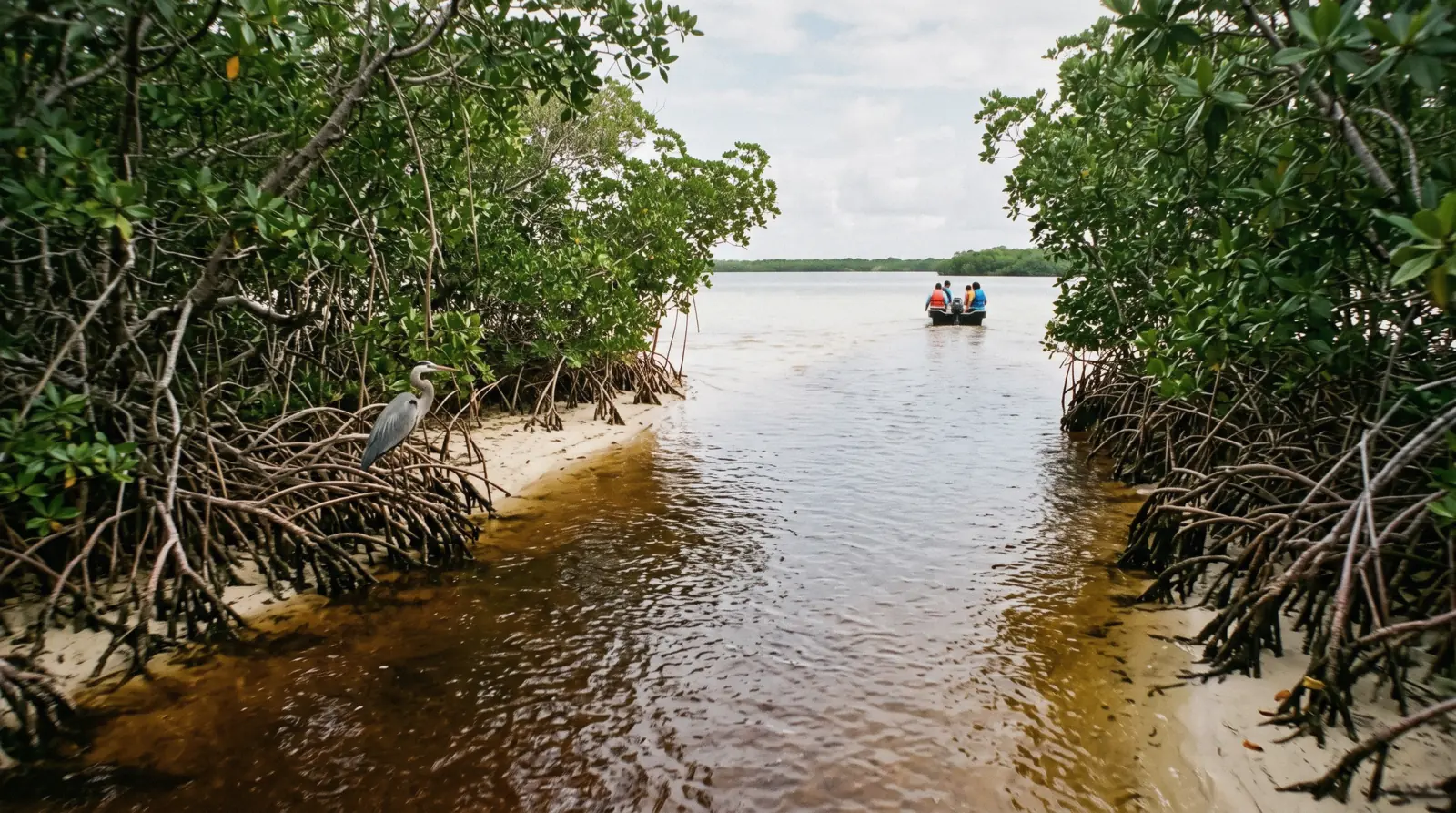
The biosphere reserve starts a few kilometres south of the hotel road: 5,280 square kilometres of mangrove, lagoon, forest and reef, a UNESCO World Heritage Site since 1987. CONANP charges MX$225 (about $13) at the gate and opens 07:00–18:00. What people come for is the float — forty minutes drifting down a canal the Maya cut to move canoes between the lagoons and the sea.
It takes a whole day and it does not combine with the ruins. The Sian Ka'an page explains the two gates and which operator holds the permit.
5. Cobá
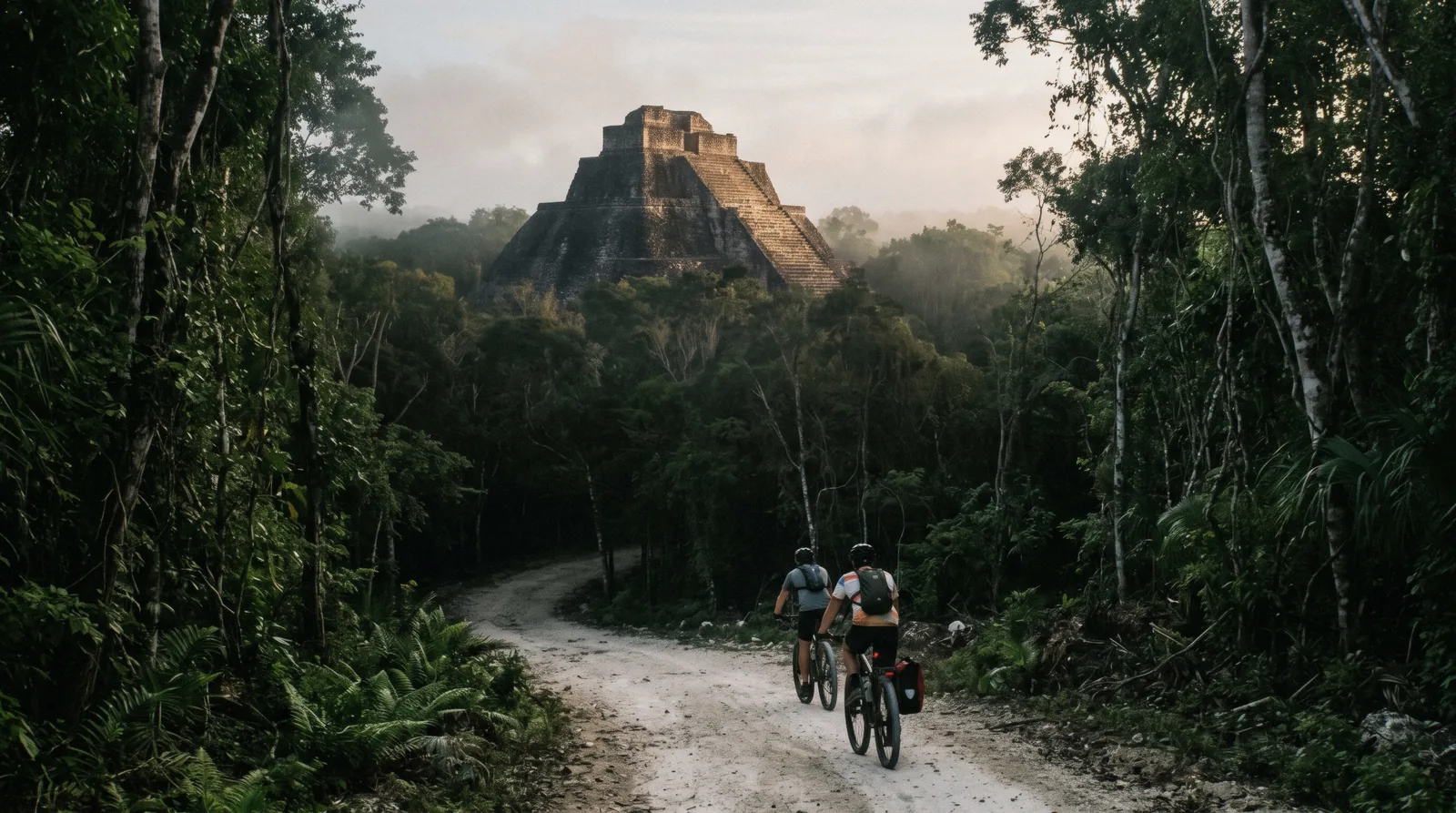
The inland capital that the coastal port worked for, 45 minutes west and a completely different climate: forest canopy, causeways and shade instead of glare. MX$210 (about $12) for a foreign adult, open 08:00–17:00 with last access at 16:00, and big enough that most visitors cross it by bicycle or pedalled tricycle. INAH's own page still publishes climbing access to the Nohoch Mul pyramid in groups of fifteen — the Cobá page sets out why that is worth asking about at the gate rather than counting on.
6. Muyil, and the quiet version of the reserve
Twenty-five minutes south on Highway 307, at the northern gate of Sian Ka'an: a small Petén-style site of steep-walled temples, inhabited from about 350 BC and tied to Cobá 44 kilometres north. MX$145 (about $9) for a foreign adult, open 08:00–17:00. The archaeological ticket, the reserve quota and the lagoon boat are three separate payments at the same gate, which is the one thing to know before you arrive — the Muyil trip that bundles all three is the reason most people book rather than drive.
7. Akumal Bay
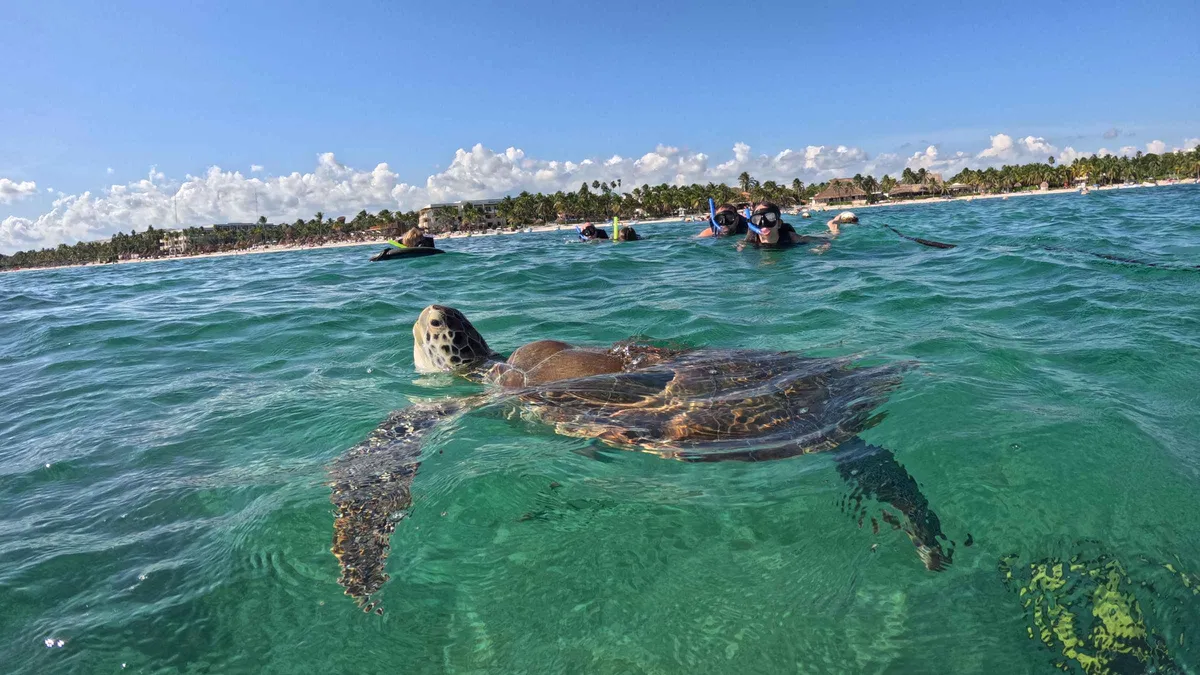
Twenty-five minutes north, and the one place on this coast where green turtles graze seagrass in water shallow enough to stand in. Swimming with them is only legal with a licensed guide inside the protected circuit, in ninety-minute slots with a life jacket and no touching — the guided swim includes the park admission and the gear. Go on the first slot of the morning: the bay is calmest, the visibility is best, and the guides put fewer people in the water at once.
8. The beaches, and the reef in front of them
Playa Paraíso sits under the same cliff line as the ruins, is public sand and has no minimum spend, which is not true of the beach clubs down the road — those charge a minimum consumption rather than an entry fee. Offshore is the Mesoamerican reef, the second longest in the world, and a two-hour snorkel from the beach reaches two spots on it for less than a day bed costs. Sargassum lands in quantity in the warmer months and nobody publishes a forecast; the cenotes and the reserve are unaffected.
What each gate charges in 2026
Every figure below was read on the operator's or the agency's own page on 29 August 2026, and every one of them is a peso price paid at the gate — the dollar figures are approximations at US$1 = MX$16.95. Where a fee is bundled or missing, the row says so instead of guessing.
Sources, in order: INAH Tulum, INAH Cobá, INAH Muyil, CONANP Sian Ka'an and Parque Dos Ojos. One caveat worth knowing before you argue at a gate: an operator selling a ruins tour on GetYourGuide prices Parque del Jaguar entry at MX$511 for foreign visitors, against INAH's MX$265. Both were read on the same day. INAH's is the agency that sets the archaeological tariff, so that is the figure this site uses — and the ticket page carries both.
What people book first in Tulum
Six options that cover the decisions above: the ruins with and without transport, the water on both sides of the road, and the reserve. Prices are in US dollars as listed by GetYourGuide on 29 August 2026; the operator charges in your own currency at checkout.
from $26.09
Riviera Maya: Tulum Ruins, Mariposa & Chen-Ha Half-Day Tour
★★★★★★★★★★4.4(1,159 reviews)· 8 - 8.5 hours
Listing details checked 2026-08-29
The cheapest way to pair the ruins with two cenote swims — hotel pickup, a guided walk, then Mariposa and Chen-Ha. Biggest review count here.
Riviera Maya: Sian Ka'an Reserve Ancient Maya Canals Tour
★★★★★★★★★★4.8(597 reviews)· 8 hours
Listing details checked 2026-08-29
Run by the Maya cooperative that holds the permit: the float down the thousand-year-old canal at Muyil, four ecosystems, breakfast on the early departure.
Built from the opening hours and the driving times above, not from a feeling: the ruins want an early morning, the reserve wants a whole day, and Chichén Itzá takes twelve hours door to door. This is what fits.
Nights
What fits
What you give up
Best for
1
Ruins at 08:00, one cenote after lunch
The reserve, the reef, any day trip
A stop between Cancún and Bacalar
2
Ruins, two cenotes, one beach afternoon
Sian Ka'an and Cobá both
A first visit with a fixed flight
3
Add a full reserve day or Cobá plus Akumal
Chichén Itzá, unless you drop a beach day
Most people — this is the honest minimum
5
All of the above, plus Chichén Itzá and a slow beach day
Nothing on this site
Divers, and anyone travelling with children
Driving times are our own, measured on Highway 307 outside the 07:00–09:00 school run: Cobá 45 minutes, Akumal 25, the Muyil gate 25, Chichén Itzá about two and a half hours each way.
Eating in Tulum without paying beach-road prices
Tulum's food splits along the same 4-kilometre line as everything else, and the difference between the two sides is larger here than anywhere else in the trip.
In the town, along Avenida Tulum and the streets behind it, you eat where the people who work on the beach road eat: taquerías with a spit in the window, cochinita pibil sold out by eleven in the morning, marquesitas from a cart at night. Behind the dune, the same meal is a tasting menu with a wine pairing, often excellent, and priced in dollars for a reason — several of the beach-road kitchens run on generators and truck in their water. Neither is a trap; they are two different products that happen to share a name. Where to eat breaks the two down street by street.
The practical part
Cash is still king at the town end and at every cenote gate — the ATMs on Avenida Tulum charge a per-withdrawal fee and the independent ones on the beach road charge more. Tap water is not drinkable anywhere in Tulum; hotels and restaurants refill bottles from garrafones, and most cenote operators list a reusable bottle in their what-to-bring section for exactly that reason. If you are eating on the beach road, book: the kitchens are small and the good ones fill by seven.
The dates that change a Tulum trip
Four things move on the calendar here, and only one of them is the weather.
Sundays. Every INAH archaeological zone in Mexico — Tulum, Cobá, Muyil, Chichén Itzá — is free on Sundays for Mexican nationals and foreign residents. The rule does not cover foreign visitors, but it does fill the Tulum car park by nine, so a Sunday morning is the one morning where being at the gate at 08:00 matters most.
Sargassum. The brown seaweed lands in quantity in the late spring and summer months. No official body publishes a forecast for a future week; the state monitoring reports are retrospective, so any site promising you a clean beach in July is guessing. Cenotes and the reserve are unaffected.
High season. December to April is the dry stretch — February averages 31 mm of rain against 199 mm in October — and it is also when the cenote car parks fill before ten.
Hurricane season. June to November on the Atlantic calendar. October is the wettest month in the thirty-year record, at 199 mm across 19.8 rain days.
Nesting turtles. The beaches below the ruins are protected nesting ground; the national park asks visitors to keep off marked sections and away from lights at night in the nesting months.
Tulum month by month
Average daily high temperature by month in Celsius, with the Fahrenheit reading underneath, computed from the Open-Meteo ERA5 reanalysis for 20.21 N, 87.47 W over 1995–2024 on 29 August 2026. The bands beneath it are what those numbers mean for a day out: the range is narrow — 26.1 °C in January to 30.4 °C in August — so in Tulum the rain, not the heat, decides the month.
26.1°C79°F
JanuaryJan
26.9°C80°F
FebruaryFeb
27.7°C82°F
MarchMar
28.8°C84°F
AprilApr
29.6°C85°F
MayMay
29.4°C85°F
JuneJun
30.1°C86°F
JulyJul
30.4°C87°F
AugustAug
29.9°C86°F
SeptemberSep
28.9°C84°F
OctoberOct
27.6°C82°F
NovemberNov
26.7°C80°F
DecemberDec
Driest stretch — under 60 mm a month, and the reason flights cost what they do
Busiest weeks at the gates — our reading, no official visitor count is published
Wettest months — 180 to 199 mm, and up to 23 days with rain
Hottest, with average highs at or above 30 °C and no shade at the ruins
Rain here arrives as afternoon downpours rather than all-day drizzle; a wet month is not a lost month, but it is a month to put the ruins at 08:00 and the cenotes after lunch.
Tulum weather and rainfall by month
Thirty-year averages from the Open-Meteo ERA5 archive for 20.21 N, 87.47 W, 1 January 1995 to 31 December 2024, computed on 29 August 2026. Rain days count any day with 1 mm or more.
Month
Average high
Average low
Rain
Rain days
January
26.1 °C (79 °F)
21.7 °C (71 °F)
51 mm
11.1
February
26.9 °C (80 °F)
22.4 °C (72 °F)
31 mm
8.3
March
27.7 °C (82 °F)
23.1 °C (74 °F)
32 mm
7.9
April
28.8 °C (84 °F)
24.4 °C (76 °F)
36 mm
7.5
May
29.6 °C (85 °F)
25.3 °C (78 °F)
92 mm
13.6
June
29.4 °C (85 °F)
25.7 °C (78 °F)
195 mm
20.1
July
30.1 °C (86 °F)
26.0 °C (79 °F)
102 mm
16.7
August
30.4 °C (87 °F)
26.0 °C (79 °F)
137 mm
19.7
September
29.9 °C (86 °F)
25.6 °C (78 °F)
182 mm
23.0
October
28.9 °C (84 °F)
24.4 °C (76 °F)
199 mm
19.8
November
27.6 °C (82 °F)
23.0 °C (73 °F)
90 mm
12.6
December
26.7 °C (80 °F)
22.3 °C (72 °F)
58 mm
12.3
The sea stays between 26 °C and 30 °C all year, which is why the cenotes — fed by groundwater at around 24 °C — feel cold when you get in and never do after five minutes.
Getting around Tulum, and what each way costs
Nothing in Tulum is far, and nearly everything is just far enough to be annoying on foot. The town centre to the beach road is about four kilometres of straight, flat, shadeless road.
A bicycle is the local answer, and rental shops in town hire them by the day. The ride to the beach road takes twenty minutes on a signed cycle path that runs beside the road; the ride back after dark is the part to think about, because the path is unlit. Colectivos — the white shared vans on Highway 307 — run constantly between Playa del Carmen, Tulum and the villages, stop when you wave, and are how everyone reaches the cenotes strung along the highway.
Taxis have no published tariff in Tulum: the fare is agreed before you get in, and the beach road carries a premium at night that catches out most first-time visitors.
Getting here
Tulum has its own international airport now, about 21 kilometres southwest of the town — what flies there — and Cancún's airport is about 90 minutes north on Highway 307. ADO's long-distance buses stop at the terminal on Avenida Tulum in the middle of town, and the Maya Train station sits west of the highway. Fares for the train are only sold inside its own booking engine — no public fare table was readable on trenmaya.gob.mx when we checked on 29 August 2026, so this site does not print one.
What a day in Tulum actually costs
Two days, both real, both built only from figures printed elsewhere on this page. The gap between them is the whole argument about whether Tulum is expensive.
The frugal version: ruins at opening on the unified fee, a colectivo up the highway, one cenote at the gate price, tacos in town, a bicycle for the beach. The comfortable version: a guided tour with pickup, a cenote park that takes cards, a beach club with a minimum spend, dinner behind the dune. Nobody needs the second to see Tulum; plenty of people are here for it.
In Tulum the address decides the trip more than the room does, because the two halves of town are four kilometres and one taxi fare apart.
The beach road gives you the dune, the sunrise and a hotel that generates its own power; it also means paying to reach a supermarket. The town gives you the ADO terminal, the banks, the cheap food and a twenty-minute cycle to the sand. The newer residential grids west and south of the centre — Aldea Zamá and La Veleta — sit between the two, are where most of the apartments are, and are the reason so many visitors end up hiring a scooter. Where to stay sets the three side by side with what a night costs in each.
Tulum, Mexico: the questions people actually ask
Is Tulum still worth visiting in 2026?
Yes, if you come for the coast and the water rather than for a scene. The ruins are the only walled Maya city on the Caribbean and now cost MX$265 in one unified payment; the cenotes inland and the reserve to the south are the same as they have always been. What has changed is the beach road, which has been priced for a different visitor for several years now — which is why this guide keeps the fees and the town separate from it.
Is Tulum better than Cancún?
They answer different questions. Cancún is a hotel zone built for a resort holiday with an airport attached; Tulum is a small town with ruins, cenotes and a biosphere reserve inside half an hour. If you want to swim in caves, float a Maya canal at Sian Ka'an and eat in a town, Tulum wins. If you want a big beach with lifeguards, a swimmable lagoon and cheaper hotels per star, Cancún does.
Why did people stop going to Tulum?
Prices on the beach road, sargassum in the summer months, and a run of coverage about taxi fares and closures. The parts of Tulum with an official price list — the ruins at MX$265, Cobá at MX$210, Dos Ojos at MX$400 — did not get more expensive in the way the beach clubs did.
Is Tulum expensive?
The gates are not: the ruins, Cobá, Muyil and the Sian Ka'an quota come to MX$845 together for a foreign adult, about $50. The beach road is, and it is possible to spend more on one dinner behind the dune than on every entrance fee of a three-day trip. What a day costs sets the two versions side by side.
How many days do you need in Tulum?
Three nights is the honest minimum for the ruins, two cenotes and one full reserve or Cobá day, because the reserve day and the archaeological morning cannot share a calendar slot. Two nights works if you drop Sian Ka'an; one night covers the ruins and a single cenote and nothing else. The nights table shows what falls off at each length.
How this guide is checked
Everything on this site is a figure someone published, or it is labelled as our own reading.
Prices and opening hours come from the agency or operator that charges them — INAH for the archaeological zones, CONANP for the national park and the biosphere reserve, Parque Dos Ojos for its own cenotes — and every page prints the date those pages were read. Where a gate publishes nothing, as most cenotes around Tulum do not, the page says so rather than repeating a number from a blog. Where two official sources disagree, both are printed with the reason we follow one of them, as with the MX$265 and MX$511 figures in the fee table.
Peso figures are the official ones; dollar approximations use the European Central Bank reference rate of 28 August 2026, US$1 = MX$16.95. Tour prices are the platform's listed figures on the day beside them, and the operator charges in your own currency at checkout. This site is not a tour operator or a ticket seller; booking links go to the platform or the official gate, and we earn a commission on some of them at no extra cost to you.
Tulum on film: the ruins, the road and the cenotes
Three walk-throughs that show what the figures on this page look like on the ground — the beach road, the cenote gates and the queue at the ruins. All three were published within the last year.
12 Things We Wish We Knew BEFORE visiting TULUM
A first-visit debrief: the taxi economics, the beach-road prices and what the ruins morning is actually like.
Video: Lloyd & Mandy
FULL Tulum Travel Guide 2026 | Budget vs Luxury
The same trip costed two ways, which is the split this page's cost table describes.
Video: Wandering Off with Sam & Alex
Tulum Travel Guide - 12 Experiences YOU MUST HAVE in 2026
A run through the cenotes, the reserve and the ruins, filmed across a week.
Video: Ian and Ana
Videos load from YouTube only when you press play.
Start with the fee table, not with a booking
The gates around Tulum charge in pesos, in cash, and change their rules without notice. Read what each one costs today, then pick the tour that saves you the queue or the taxi.
Prices and availability are set by the operator and confirmed at checkout; official ticket-office links on this site are never affiliate links.
The office, phone and email above belong to the city's own visitor service, published on the official tourism site and checked on 2026-08-29 — they are not this site's contact details. To reach us, use the contact page.
 Tulum City Guide
 from $26.09